

Trends Every Investor Should Know
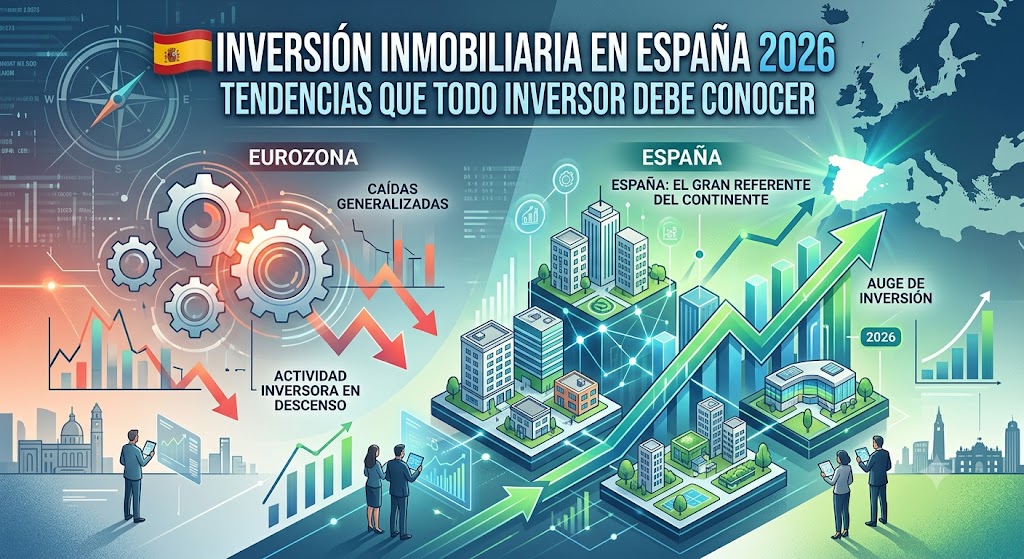
The Spanish real estate market has started 2026 with an energy that few other European markets can match. While the Eurozone is experiencing widespread declines in investment activity, Spain is consolidating its position as the continent's leading market. These are the key trends shaping the year.
1. Spain breaks away from Europe: a historic Q1
Real estate investment in Spain reached €6.3 billion in the first quarter of 2026, representing a 93% increase compared to the same period of the previous year, according to CBRE data. Transaction volume is also 103% above the average of the last 10 years. Idealista
This figure represents a 45.4% increase compared to the average recorded in 2025, in a context where the Eurozone has experienced an average decline of 26% over the same period. This divergence is striking and reflects the structural strength of the Spanish market compared to the rest of the continent. Brains Real Estate News
2. Living becomes the engine of investment
The living sector —including rental properties, student residences, flex living , and senior living —led the investment, representing 36% of the total and more than €2.25 billion, a 98% increase over the previous year. Idealista
This progress is driven primarily by the growth of the multifamily or build-to-rent (BTR) model, as well as by the development of affordable housing through public-private partnerships, which are becoming a major investment strategy for institutional capital. Brains Real Estate News
This segment also includes formats that have gone from being alternative to structural: student residences, flex living , and coliving , which respond to profound changes in lifestyles, job mobility, and the internationalization of demand. Actlegal
3. Retail and Offices recover ground
El retail alcanzó los 1.140 millones de euros en inversión, un incremento del 84,8% respecto a la media de 2025. Este crecimiento ha estado impulsado por el interés en centros comerciales, parques comerciales y activos high street prime, especialmente en estrategias Core+ y value added. Por su parte, el mercado de oficinas registró 923 millones de euros, con un aumento del 58,7%, concentrándose la inversión en activos prime con criterios ESG y operaciones de reposicionamiento. Brains Real Estate News
4. Los precios siguen subiendo: entre el 5% y el 9%
El mercado inmobiliario español en 2026 se define por una paradoja: precios récord coexistiendo con una demanda insaciable que la oferta no puede satisfacer. El déficit estructural de vivienda, alimentado por la inmigración, la formación acelerada de hogares y una producción de obra nueva insuficiente, seguirá presionando los precios al alza al menos un +5% a +9% este año. Selekta Properties
Bankinter estima una subida media del 7% en España para 2026, y BBVA Research espera un aumento del 5,3%, con una demanda fuerte y una oferta limitada. fotocasa
5. El alquiler, bajo presión máxima
Idealista estimó que en enero de 2026 el alquiler medio en España se situaba en 15 euros por metro cuadrado, con una subida interanual del 8,1%. En Madrid, Barcelona y zonas costeras los precios se sitúan entre los 20 y los 24 €/m²/mes, con previsiones de incrementos medios adicionales de entre el 6% y el 8% a lo largo del año. PRO CORPfotocasa
6. La demanda extranjera sigue siendo un pilar estructural
El comprador no residente paga de media 3.126 €/m², casi el doble que el comprador español (1.809 €/m²). Los norteamericanos son los que más gastan: 4.583 €/m². Las zonas más demandadas por extranjeros siguen siendo Alicante (45,7% de las transacciones), Baleares (32,8%), Málaga (32,3%) y Canarias (30,7%). Selekta Properties
La eliminación de la Golden Visa no ha enfriado el interés: su impacto real en el mercado siempre fue limitado —apenas 2.000 solicitudes anuales— y su supresión no ha frenado la demanda extranjera. Selekta Properties
7. La sostenibilidad energética, ya no opcional
El 95% del parque residencial español tiene calificación energética D o inferior, y la UE exige que todas las viviendas alcancen al menos la clase E para 2030. Las viviendas con certificación A o B se venden un 9,7% más caras, según datos del Banco de España. Para los inversores, rehabilitar activos con baja calificación energética representa una de las oportunidades de creación de valor más claras del ciclo actual. Selekta Properties
8. Data Centers: el activo alternativo que despega
Investment in data center construction in Spain reached €4.927 billion last year, a figure that has skyrocketed by 119% in just two years, positioning the country as one of the European markets with the greatest potential in this sector. Idealista
Conclusion: selectivity and local focus, the key to the cycle
Capital will become more selective, prioritizing core and core-plus strategies, with a clear focus on value preservation, operational efficiency, and sustainability. The market will become increasingly heterogeneous geographically: major cities and their surrounding areas will continue to concentrate the majority of demand, while other locations will show more restrained growth, dependent on local factors. Actlegal
For institutional or private investors, 2026 in Spain is not a year to bet blindly, but to move with data, criteria and deep knowledge of the local market.


 English
 French
 German
 Russian
 Spanish